In North America, the Relatively High Incidence of Expanded Family Households in the Lower Class Is
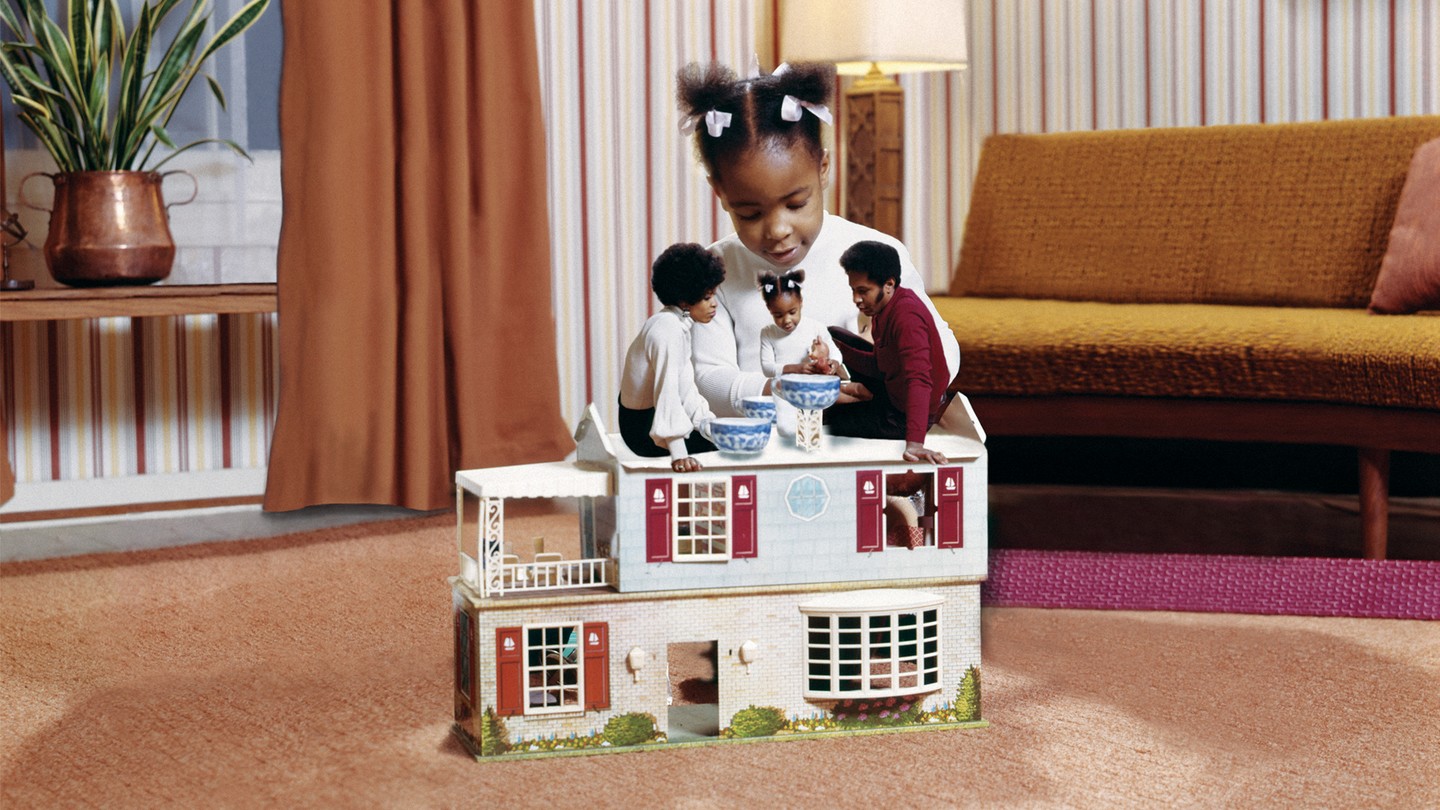
The Nuclear Family Was a Mistake
The family structure nosotros've held upwardly every bit the cultural platonic for the past one-half century has been a ending for many. It'south time to figure out better ways to live together.
The scene is one many of us accept somewhere in our family history: Dozens of people jubilant Thanksgiving or some other holiday effectually a makeshift stretch of family unit tables—siblings, cousins, aunts, uncles, great-aunts. The grandparents are telling the former family stories for the 37th time. "It was the about beautiful identify you've ever seen in your life," says 1, remembering his starting time day in America. "At that place were lights everywhere … It was a celebration of calorie-free! I thought they were for me."
To hear more feature stories, get the Audm iPhone app.
The oldsters start squabbling about whose memory is better. "Information technology was cold that twenty-four hour period," 1 says about some faraway retentiveness. "What are you talking about? It was May, late May," says some other. The young children sit wide-eyed, absorbing family lore and trying to slice together the plotline of the generations.
After the meal, in that location are piles of plates in the sink, squads of children conspiring mischievously in the basement. Groups of young parents huddle in a hallway, making plans. The erstwhile men nap on couches, waiting for dessert. It'due south the extended family unit in all its tangled, loving, exhausting celebrity.
This detail family is the one depicted in Barry Levinson'southward 1990 film, Avalon, based on his own childhood in Baltimore. V brothers came to America from Eastern Europe around the time of Globe War I and congenital a wallpaper business. For a while they did everything together, like in the old country. But every bit the picture show goes along, the extended family begins to split apart. Some members motility to the suburbs for more privacy and infinite. One leaves for a job in a different state. The big blowup comes over something that seems picayune but isn't: The eldest of the brothers arrives late to a Thanksgiving dinner to notice that the family has begun the meal without him.
"You cut the turkey without me?" he cries. "Your own flesh and claret! … You cut the turkey?" The pace of life is speeding up. Convenience, privacy, and mobility are more than important than family loyalty. "The idea that they would eat before the brother arrived was a sign of disrespect," Levinson told me recently when I asked him about that scene. "That was the real crack in the family unit. When you violate the protocol, the whole family structure begins to plummet."
Every bit the years get by in the motion picture, the extended family plays a smaller and smaller office. By the 1960s, there's no extended family unit at Thanksgiving. Information technology'south just a young male parent and mother and their son and girl, eating turkey off trays in front end of the television. In the terminal scene, the master grapheme is living lone in a nursing abode, wondering what happened. "In the end, you spend everything yous've ever saved, sell everything you've ever endemic, simply to exist in a place similar this."
"In my babyhood," Levinson told me, "you'd get together around the grandparents and they would tell the family stories … Now individuals sit down around the Television, watching other families' stories." The main theme of Avalon, he said, is "the decentralization of the family. And that has continued even further today. Once, families at least gathered effectually the television receiver. At present each person has their own screen."
This is the story of our times—the story of the family, once a dense cluster of many siblings and extended kin, fragmenting into ever smaller and more than frail forms. The initial result of that fragmentation, the nuclear family unit, didn't seem so bad. But then, because the nuclear family is so brittle, the fragmentation continued. In many sectors of society, nuclear families fragmented into unmarried-parent families, single-parent families into chaotic families or no families.
If you want to summarize the changes in family unit structure over the past century, the truest affair to say is this: We've made life freer for individuals and more unstable for families. We've fabricated life better for adults but worse for children. Nosotros've moved from large, interconnected, and extended families, which helped protect the most vulnerable people in social club from the shocks of life, to smaller, discrete nuclear families (a married couple and their children), which give the most privileged people in society room to maximize their talents and expand their options. The shift from bigger and interconnected extended families to smaller and detached nuclear families ultimately led to a familial system that liberates the rich and ravages the working-grade and the poor.
This commodity is about that process, and the destruction information technology has wrought—and about how Americans are now groping to build new kinds of family and find amend ways to live.
Role I
The Era of Extended Clans
Through the early on parts of American history, almost people lived in what, by today's standards, were large, sprawling households. In 1800, three-quarters of American workers were farmers. Most of the other quarter worked in small-scale family businesses, similar dry out-appurtenances stores. People needed a lot of labor to run these enterprises. It was not uncommon for married couples to take seven or 8 children. In addition, there might be stray aunts, uncles, and cousins, equally well as unrelated servants, apprentices, and farmhands. (On some southern farms, of course, enslaved African Americans were also an integral part of production and work life.)
Steven Ruggles, a professor of history and population studies at the University of Minnesota, calls these "corporate families"—social units organized around a family unit business. According to Ruggles, in 1800, ninety pct of American families were corporate families. Until 1850, roughly three-quarters of Americans older than 65 lived with their kids and grandkids. Nuclear families existed, but they were surrounded by extended or corporate families.
Extended families have ii groovy strengths. The first is resilience. An extended family is i or more families in a supporting web. Your spouse and children come first, but there are also cousins, in-laws, grandparents—a circuitous web of relationships among, say, seven, ten, or 20 people. If a mother dies, siblings, uncles, aunts, and grandparents are there to step in. If a human relationship between a begetter and a kid ruptures, others can make full the alienation. Extended families accept more than people to share the unexpected burdens—when a kid gets sick in the middle of the day or when an adult unexpectedly loses a task.
A detached nuclear family unit, by contrast, is an intense set of relationships among, say, iv people. If i human relationship breaks, there are no stupor absorbers. In a nuclear family, the terminate of the wedlock means the finish of the family as it was previously understood.
The 2nd corking strength of extended families is their socializing force. Multiple adults teach children right from incorrect, how to conduct toward others, how to be kind. Over the class of the 18th and 19th centuries, industrialization and cultural change began to threaten traditional ways of life. Many people in Britain and the United States doubled down on the extended family in lodge to create a moral haven in a heartless world. According to Ruggles, the prevalence of extended families living together roughly doubled from 1750 to 1900, and this way of life was more than common than at whatsoever fourth dimension before or since.
During the Victorian era, the idea of "hearth and home" became a cultural ideal. The abode "is a sacred place, a vestal temple, a temple of the hearth watched over by Household Gods, before whose faces none may come up but those whom they can receive with honey," the great Victorian social critic John Ruskin wrote. This shift was led by the upper-middle class, which was coming to see the family less as an economic unit and more as an emotional and moral unit, a rectory for the formation of hearts and souls.
Only while extended families have strengths, they tin also exist exhausting and stifling. They allow footling privacy; yous are forced to be in daily intimate contact with people you didn't choose. There'southward more stability but less mobility. Family unit bonds are thicker, merely individual choice is diminished. You take less space to make your ain way in life. In the Victorian era, families were patriarchal, favoring men in general and beginning-born sons in particular.
As factories opened in the large U.S. cities, in the late 19th and early 20th centuries, young men and women left their extended families to chase the American dream. These young people married as presently as they could. A young man on a farm might expect until 26 to go married; in the alone metropolis, men married at 22 or 23. From 1890 to 1960, the average age of offset union dropped past 3.six years for men and 2.2 years for women.
The families they started were nuclear families. The decline of multigenerational cohabiting families exactly mirrors the decline in farm employment. Children were no longer raised to assume economical roles—they were raised and so that at adolescence they could fly from the nest, go contained, and seek partners of their own. They were raised not for embeddedness but for autonomy. By the 1920s, the nuclear family with a male breadwinner had replaced the corporate family unit as the ascendant family class. Past 1960, 77.5 percent of all children were living with their two parents, who were married, and apart from their extended family unit.
The Short, Happy Life of the Nuclear Family unit
For a time, it all seemed to work. From 1950 to 1965, divorce rates dropped, fertility rates rose, and the American nuclear family seemed to be in wonderful shape. And most people seemed prosperous and happy. In these years, a kind of cult formed effectually this type of family—what McCall'south, the leading women'southward mag of the twenty-four hours, called "togetherness." Good for you people lived in two-parent families. In a 1957 survey, more than half of the respondents said that unmarried people were "sick," "immoral," or "neurotic."
During this menses, a certain family ideal became engraved in our minds: a married couple with 2.v kids. When we think of the American family, many of united states of america still revert to this ideal. When we have debates about how to strengthen the family, we are thinking of the two-parent nuclear family, with one or two kids, probably living in some detached family unit dwelling house on some suburban street. We accept it as the norm, fifty-fifty though this wasn't the way nearly humans lived during the tens of thousands of years earlier 1950, and it isn't the way most humans take lived during the 55 years since 1965.
Today, only a minority of American households are traditional two-parent nuclear families and only 1-third of American individuals live in this kind of family. That 1950–65 window was not normal. Information technology was a freakish historical moment when all of society conspired, wittingly and not, to obscure the essential fragility of the nuclear family.
For one matter, about women were relegated to the dwelling house. Many corporations, well into the mid-20th century, barred married women from employment: Companies would rent unmarried women, merely if those women got married, they would take to quit. Demeaning and disempowering treatment of women was rampant. Women spent enormous numbers of hours trapped inside the dwelling house under the headship of their husband, raising children.
For another thing, nuclear families in this era were much more connected to other nuclear families than they are today—constituting a "modified extended family unit," equally the sociologist Eugene Litwak calls it, "a coalition of nuclear families in a state of mutual dependence." Fifty-fifty as late as the 1950s, before television and air-conditioning had fully caught on, people connected to live on ane another'south front end porches and were office of one another's lives. Friends felt complimentary to discipline one another'south children.
In his book The Lost Metropolis, the journalist Alan Ehrenhalt describes life in mid-century Chicago and its suburbs:
To exist a immature homeowner in a suburb like Elmhurst in the 1950s was to participate in a communal enterprise that only the nearly adamant loner could escape: barbecues, coffee klatches, volleyball games, babe-sitting co-ops and constant bartering of household goods, kid rearing by the nearest parents who happened to be effectually, neighbors wandering through the door at any hour without knocking—all these were devices by which young adults who had been set down in a wilderness of tract homes made a community. Information technology was a life lived in public.
Finally, conditions in the wider society were platonic for family unit stability. The postwar flow was a high-h2o mark of church building attendance, unionization, social trust, and mass prosperity—all things that correlate with family cohesion. A human being could relatively easily observe a job that would allow him to be the breadwinner for a single-income family unit. By 1961, the median American homo historic period 25 to 29 was earning almost 400 per centum more his father had earned at about the same age.
In short, the catamenia from 1950 to 1965 demonstrated that a stable society can be built around nuclear families—so long as women are relegated to the household, nuclear families are so intertwined that they are basically extended families by another name, and every economic and sociological condition in order is working together to support the institution.
Video: How the Nuclear Family unit Broke Downward
Disintegration
Simply these conditions did not terminal. The constellation of forces that had briefly shored upwardly the nuclear family began to fall away, and the sheltered family of the 1950s was supplanted by the stressed family unit of every decade since. Some of the strains were economic. Starting in the mid-'70s, young men's wages declined, putting pressure on working-class families in particular. The major strains were cultural. Society became more individualistic and more than cocky-oriented. People put greater value on privacy and autonomy. A rising feminist movement helped endow women with greater freedom to live and work equally they chose.
A report of women's magazines past the sociologists Francesca Cancian and Steven L. Gordon found that from 1900 to 1979, themes of putting family earlier self dominated in the 1950s: "Love means self-sacrifice and compromise." In the 1960s and '70s, putting self before family was prominent: "Dear means cocky-expression and individuality." Men captivated these cultural themes, too. The primary trend in Baby Boomer culture generally was liberation—"Free Bird," "Born to Run," "Ramblin' Man."
Eli Finkel, a psychologist and union scholar at Northwestern Academy, has argued that since the 1960s, the ascendant family culture has been the "self-expressive marriage." "Americans," he has written, "at present expect to marriage increasingly for self-discovery, self-esteem and personal growth." Marriage, according to the sociologists Kathryn Edin and Maria Kefalas, "is no longer primarily nearly childbearing and childrearing. At present marriage is primarily about developed fulfillment."
This cultural shift was very practiced for some adults, merely it was not so good for families by and large. Fewer relatives are effectually in times of stress to assist a couple work through them. If you married for love, staying together made less sense when the love died. This attenuation of marital ties may have begun during the late 1800s: The number of divorces increased near fifteenfold from 1870 to 1920, and then climbed more or less continuously through the starting time several decades of the nuclear-family era. As the intellectual historian Christopher Lasch noted in the late 1970s, the American family didn't start coming autonomously in the 1960s; it had been "coming apart for more than 100 years."
Americans today have less family than ever earlier. From 1970 to 2012, the share of households consisting of married couples with kids has been cutting in half. In 1960, according to census data, simply thirteen percent of all households were single-person households. In 2018, that figure was 28 per centum. In 1850, 75 per centum of Americans older than 65 lived with relatives; past 1990, only 18 percent did.
Over the by two generations, people have spent less and less time in marriage—they are marrying subsequently, if at all, and divorcing more. In 1950, 27 percent of marriages ended in divorce; today, about 45 percent do. In 1960, 72 pct of American adults were married. In 2017, almost one-half of American adults were single. According to a 2014 report from the Urban Constitute, roughly 90 percent of Baby Boomer women and 80 pct of Gen X women married past age 40, while only about 70 percent of late-Millennial women were expected to exercise and then—the lowest charge per unit in U.S. history. And while more than four-fifths of American adults in a 2019 Pew Enquiry Centre survey said that getting married is not essential to living a fulfilling life, it's not just the institution of matrimony they're eschewing: In 2004, 33 percent of Americans ages 18 to 34 were living without a romantic partner, according to the General Social Survey; by 2018, that number was upwardly to 51 percent.
Over the by two generations, families have also gotten a lot smaller. The general American birth rate is half of what it was in 1960. In 2012, most American family households had no children. In that location are more American homes with pets than with kids. In 1970, near 20 percent of households had five or more people. As of 2012, but 9.6 percentage did.
Over the by ii generations, the concrete space separating nuclear families has widened. Before, sisters-in-law shouted greetings across the street at each other from their porches. Kids would dash from home to home and eat out of whoever'south fridge was closest by. But lawns have grown more expansive and porch life has declined, creating a buffer of space that separates the business firm and family from anyone else. As Mandy Len Catron recently noted in The Atlantic, married people are less likely to visit parents and siblings, and less inclined to assistance them do chores or offer emotional support. A code of family cocky-sufficiency prevails: Mom, Dad, and the kids are on their own, with a bulwark around their island home.
Finally, over the past two generations, families take grown more diff. America now has two entirely different family unit regimes. Amid the highly educated, family patterns are almost every bit stable as they were in the 1950s; among the less fortunate, family life is often utter chaos. There'south a reason for that carve up: Flush people accept the resource to effectively buy extended family, in gild to shore themselves up. Retrieve of all the kid-rearing labor affluent parents now buy that used to be done by extended kin: babysitting, professional kid care, tutoring, coaching, therapy, expensive afterwards-school programs. (For that matter, retrieve of how the affluent can rent therapists and life coaches for themselves, as replacement for kin or close friends.) These expensive tools and services not only support children's development and assistance prepare them to compete in the meritocracy; by reducing stress and time commitments for parents, they preserve the amity of marriage. Flush conservatives ofttimes pat themselves on the dorsum for having stable nuclear families. They preach that everybody else should build stable families too. But then they ignore one of the chief reasons their own families are stable: They can beget to buy the support that extended family used to provide—and that the people they preach at, farther down the income calibration, cannot.
In 1970, the family unit structures of the rich and poor did non differ that greatly. Now there is a chasm between them. As of 2005, 85 percent of children born to upper-middle-class families were living with both biological parents when the mom was 40. Among working-course families, only thirty per centum were. According to a 2012 report from the National Eye for Health Statistics, college-educated women ages 22 to 44 have a 78 percent chance of having their first marriage last at least 20 years. Women in the same age range with a high-school degree or less have just most a forty per centum chance. Among Americans ages eighteen to 55, only 26 percent of the poor and 39 per centum of the working class are currently married. In her book Generation Unbound, Isabel Sawhill, an economist at the Brookings Institution, cited research indicating that differences in family unit structure take "increased income inequality by 25 percent." If the U.S. returned to the marriage rates of 1970, child poverty would be 20 percent lower. As Andrew Cherlin, a sociologist at Johns Hopkins University, in one case put it, "It is the privileged Americans who are marrying, and marrying helps them stay privileged."
When you lot put everything together, nosotros're likely living through the most rapid alter in family structure in man history. The causes are economic, cultural, and institutional all at once. People who grow up in a nuclear family tend to have a more individualistic heed-set than people who grow upward in a multigenerational extended clan. People with an individualistic mind-set tend to be less willing to cede self for the sake of the family unit, and the result is more family disruption. People who abound upwardly in disrupted families accept more than trouble getting the pedagogy they need to accept prosperous careers. People who don't take prosperous careers take problem building stable families, because of financial challenges and other stressors. The children in those families become more isolated and more traumatized.
Many people growing up in this era have no secure base from which to launch themselves and no well-divers pathway to adulthood. For those who have the human majuscule to explore, fall downwardly, and take their autumn cushioned, that means great freedom and opportunity—and for those who lack those resources, it tends to mean dandy confusion, drift, and pain.
Over the past 50 years, federal and state governments have tried to mitigate the deleterious furnishings of these trends. They've tried to increment matrimony rates, push down divorce rates, boost fertility, and all the residue. The focus has always been on strengthening the nuclear family, not the extended family unit. Occasionally, a discrete plan will yield some positive results, just the widening of family unit inequality continues unabated.
The people who suffer the nearly from the decline in family support are the vulnerable—especially children. In 1960, roughly 5 pct of children were born to unmarried women. Now about 40 percent are. The Pew Research Center reported that xi percent of children lived apart from their begetter in 1960. In 2010, 27 per centum did. At present nigh half of American children will spend their childhood with both biological parents. Twenty percent of immature adults have no contact at all with their begetter (though in some cases that's because the father is deceased). American children are more than probable to live in a single-parent household than children from any other state.
Nosotros all know stable and loving single-parent families. Only on boilerplate, children of single parents or unmarried cohabiting parents tend to accept worse wellness outcomes, worse mental-wellness outcomes, less academic success, more behavioral issues, and higher truancy rates than do children living with their 2 married biological parents. According to work by Richard Five. Reeves, a co-director of the Center on Children and Families at the Brookings Establishment, if you are born into poverty and raised past your married parents, you have an 80 percentage chance of climbing out of information technology. If you are built-in into poverty and raised by an unmarried mother, you have a l percent adventure of remaining stuck.
It's not just the lack of relationships that hurts children; it's the churn. According to a 2003 written report that Andrew Cherlin cites, 12 pct of American kids had lived in at least 3 "parental partnerships" earlier they turned xv. The transition moments, when mom's old partner moves out or her new partner moves in, are the hardest on kids, Cherlin shows.
While children are the vulnerable group well-nigh obviously affected by recent changes in family structure, they are non the only i.
Consider unmarried men. Extended families provided men with the fortifying influences of male bonding and female person companionship. Today many American males spend the first 20 years of their life without a begetter and the adjacent 15 without a spouse. Kay Hymowitz of the Manhattan Plant has spent a adept clamper of her career examining the wreckage caused past the decline of the American family, and cites bear witness showing that, in the absenteeism of the connection and meaning that family provides, single men are less healthy—alcohol and drug abuse are common—earn less, and die sooner than married men.
For women, the nuclear-family structure imposes different pressures. Though women take benefited greatly from the loosening of traditional family structures—they take more liberty to choose the lives they desire—many mothers who determine to heighten their immature children without extended family nearby notice that they have chosen a lifestyle that is brutally hard and isolating. The state of affairs is exacerbated past the fact that women nonetheless spend significantly more than time on housework and child care than men do, according to recent information. Thus, the reality we meet around us: stressed, tired mothers trying to balance work and parenting, and having to reschedule work when family life gets messy.
Without extended families, older Americans have also suffered. According to the AARP, 35 percent of Americans over 45 say they are chronically lonely. Many older people are now "elderberry orphans," with no close relatives or friends to take intendance of them. In 2015, The New York Times ran an article called "The Lonely Decease of George Bell," about a family-less 72-twelvemonth-old man who died solitary and rotted in his Queens apartment for so long that by the time constabulary found him, his body was unrecognizable.
Finally, because groups that accept endured greater levels of discrimination tend to have more fragile families, African Americans accept suffered disproportionately in the era of the detached nuclear family. Nearly one-half of blackness families are led by an unmarried single adult female, compared with less than one-sixth of white families. (The loftier rate of black incarceration guarantees a shortage of available men to exist husbands or caretakers of children.) According to census data from 2010, 25 percent of black women over 35 have never been married, compared with eight per centum of white women. Two-thirds of African American children lived in single-parent families in 2018, compared with a quarter of white children. Black single-parent families are almost concentrated in precisely those parts of the country in which slavery was most prevalent. Enquiry by John Republic of iceland, a professor of sociology and demography at Penn Country, suggests that the differences between white and black family unit construction explain xxx pct of the affluence gap between the two groups.
In 2004, the journalist and urbanist Jane Jacobs published her final book, an assessment of North American lodge called Dark Age Ahead. At the core of her argument was the idea that families are "rigged to neglect." The structures that once supported the family no longer exist, she wrote. Jacobs was likewise pessimistic well-nigh many things, but for millions of people, the shift from large and/or extended families to detached nuclear families has indeed been a disaster.
Every bit the social structures that support the family accept rust-covered, the fence most it has taken on a mythical quality. Social conservatives insist that nosotros can bring the nuclear family back. Just the weather that made for stable nuclear families in the 1950s are never returning. Conservatives take nothing to say to the kid whose dad has carve up, whose mom has had three other kids with different dads; "become alive in a nuclear family" is really not relevant advice. If merely a minority of households are traditional nuclear families, that means the majority are something else: single parents, never-married parents, composite families, grandparent-headed families, series partnerships, and so on. Bourgeois ideas have not caught upwardly with this reality.
Progressives, meanwhile, still talk like self-expressive individualists of the 1970s: People should have the freedom to choice whatever family course works for them. And, of course, they should. But many of the new family unit forms do non work well for most people—and while progressive elites say that all family structures are fine, their own beliefs suggests that they believe otherwise. As the sociologist Westward. Bradford Wilcox has pointed out, highly educated progressives may talk a tolerant game on family unit structure when speaking about society at large, simply they have extremely strict expectations for their own families. When Wilcox asked his University of Virginia students if they thought having a child out of wedlock was incorrect, 62 per centum said it was not incorrect. When he asked the students how their own parents would feel if they themselves had a kid out of spousal relationship, 97 pct said their parents would "freak out." In a contempo survey past the Institute for Family Studies, higher-educated Californians ages 18 to l were less likely than those who hadn't graduated from college to say that having a infant out of union is wrong. Only they were more likely to say that personally they did not approve of having a baby out of wedlock.
In other words, while social conservatives have a philosophy of family life they can't operationalize, because it no longer is relevant, progressives have no philosophy of family unit life at all, considering they don't want to seem judgmental. The sexual revolution has come and gone, and it's left us with no governing norms of family unit life, no guiding values, no articulated ideals. On this most central issue, our shared civilisation oftentimes has nada relevant to say—and and then for decades things have been falling apart.
The skilful news is that human beings adapt, fifty-fifty if politics are slow to practice so. When one family form stops working, people cast about for something new—sometimes finding it in something very old.
Part 2
Redefining Kinship
In the get-go was the band. For tens of thousands of years, people commonly lived in small bands of, say, 25 people, which linked upward with mayhap 20 other bands to form a tribe. People in the ring went out foraging for food and brought it back to share. They hunted together, fought wars together, fabricated clothing for i another, looked after one another's kids. In every realm of life, they relied on their extended family and wider kin.
Except they didn't ascertain kin the manner we do today. We call up of kin as those biologically related to us. Merely throughout most of human history, kinship was something you could create.
Anthropologists accept been arguing for decades about what exactly kinship is. Studying traditional societies, they have found wide varieties of created kinship amongst different cultures. For the Ilongot people of the Philippines, people who migrated somewhere together are kin. For the New Guineans of the Nebilyer Valley, kinship is created by sharing grease—the life strength establish in mother's milk or sweetness potatoes. The Chuukese people in Micronesia take a proverb: "My sibling from the aforementioned canoe"; if two people survive a dangerous trial at sea, then they become kin. On the Alaskan Due north Gradient, the Inupiat name their children later expressionless people, and those children are considered members of their namesake's family.
In other words, for vast stretches of human being history people lived in extended families consisting of non merely people they were related to just people they chose to cooperate with. An international research squad recently did a genetic analysis of people who were buried together—and therefore presumably lived together—34,000 years agone in what is at present Russia. They found that the people who were buried together were not closely related to one another. In a study of 32 nowadays-day foraging societies, main kin—parents, siblings, and children—commonly made up less than ten pct of a residential ring. Extended families in traditional societies may or may not have been genetically shut, but they were probably emotionally closer than most of us can imagine. In a beautiful essay on kinship, Marshall Sahlins, an anthropologist at the University of Chicago, says that kin in many such societies share a "mutuality of being." The late religion scholar J. Prytz-Johansen wrote that kinship is experienced as an "inner solidarity" of souls. The late South African anthropologist Monica Wilson described kinsmen as "mystically dependent" on 1 another. Kinsmen belong to one another, Sahlins writes, because they meet themselves every bit "members of one some other."
Back in the 17th and 18th centuries, when European Protestants came to North America, their relatively individualistic culture existed alongside Native Americans' very communal civilization. In his book Tribe, Sebastian Junger describes what happened next: While European settlers kept defecting to go alive with Native American families, well-nigh no Native Americans e'er defected to become live with European families. Europeans occasionally captured Native Americans and forced them to come live with them. They taught them English and educated them in Western ways. But near every time they were able, the indigenous Americans fled. European settlers were sometimes captured by Native Americans during wars and brought to alive in Native communities. They rarely tried to run away. This bothered the Europeans. They had the superior civilization, so why were people voting with their feet to go live in another way?
When yous read such accounts, you can't help but wonder whether our civilization has somehow fabricated a gigantic mistake.
We can't get back, of course. Western individualists are no longer the kind of people who alive in prehistoric bands. We may even no longer be the kind of people who were featured in the early scenes of Avalon. We value privacy and individual freedom also much.
Our civilization is oddly stuck. We want stability and rootedness, simply also mobility, dynamic capitalism, and the liberty to prefer the lifestyle we cull. We want shut families, but not the legal, cultural, and sociological constraints that made them possible. We've seen the wreckage left behind by the collapse of the detached nuclear family. We've seen the rising of opioid addiction, of suicide, of low, of inequality—all products, in part, of a family unit structure that is as well fragile, and a society that is too discrete, disconnected, and distrustful. And yet we can't quite render to a more than commonage world. The words the historians Steven Mintz and Susan Kellogg wrote in 1988 are even truer today: "Many Americans are groping for a new paradigm of American family unit life, but in the meantime a profound sense of confusion and ambivalence reigns."
From Nuclear Families to Forged Families
Yet recent signs suggest at least the possibility that a new family prototype is emerging. Many of the statistics I've cited are dire. But they describe the past—what got us to where we are at present. In reaction to family chaos, accumulating prove suggests, the prioritization of family is first to make a comeback. Americans are experimenting with new forms of kinship and extended family in search of stability.
Usually behavior changes before we realize that a new cultural paradigm has emerged. Imagine hundreds of millions of tiny arrows. In times of social transformation, they shift direction—a few at start, and then a lot. Nobody notices for a while, simply then somewhen people begin to recognize that a new pattern, and a new fix of values, has emerged.
That may exist happening now—in part out of necessity but in part by choice. Since the 1970s, and especially since the 2008 recession, economic pressures have pushed Americans toward greater reliance on family. Starting around 2012, the share of children living with married parents began to inch upward. And higher students accept more contact with their parents than they did a generation agone. We tend to deride this as helicopter parenting or a failure to launch, and it has its excesses. But the educational process is longer and more than expensive these days, and then it makes sense that young adults rely on their parents for longer than they used to.
In 1980, only 12 percent of Americans lived in multigenerational households. Only the financial crisis of 2008 prompted a precipitous rise in multigenerational homes. Today 20 per centum of Americans—64 million people, an all-time high—live in multigenerational homes.
The revival of the extended family has largely been driven by immature adults moving back abode. In 2014, 35 percentage of American men ages 18 to 34 lived with their parents. In time this shift might show itself to be mostly good for you, impelled not just by economic necessity but by beneficent social impulses; polling data advise that many young people are already looking ahead to helping their parents in sometime age.
Some other chunk of the revival is attributable to seniors moving in with their children. The pct of seniors who live solitary peaked around 1990. Now more than than a fifth of Americans 65 and over live in multigenerational homes. This doesn't count the large share of seniors who are moving to be close to their grandkids but not into the same household.
Immigrants and people of colour—many of whom confront greater economic and social stress—are more than likely to live in extended-family households. More than than 20 percent of Asians, blackness people, and Latinos live in multigenerational households, compared with 16 percent of white people. As America becomes more diverse, extended families are becoming more than common.
African Americans have always relied on extended family unit more than than white Americans practice. "Despite the forces working to separate us—slavery, Jim Crow, forced migration, the prison system, gentrification—we have maintained an incredible commitment to each other," Mia Birdsong, the author of the forthcoming book How Nosotros Prove Up, told me recently. "The reality is, black families are expansive, fluid, and brilliantly rely on the support, knowledge, and chapters of 'the hamlet' to take care of each other. Here's an illustration: The white researcher/social worker/whatever sees a kid moving betwixt their female parent'south house, their grandparents' business firm, and their uncle'due south house and sees that equally 'instability.' But what's actually happening is the family (extended and chosen) is leveraging all of its resources to heighten that kid."
The blackness extended family unit survived even nether slavery, and all the forced family separations that involved. Family was essential in the Jim Crow Due south and in the inner cities of the Due north, as a way to cope with the stresses of mass migration and limited opportunities, and with structural racism. Only government policy sometimes made it more than hard for this family course to thrive. I began my career as a police reporter in Chicago, writing nearly public-housing projects like Cabrini-Green. Guided by social-scientific discipline research, politicians tore down neighborhoods of rickety low-ascent buildings—uprooting the complex webs of social connection those buildings supported, despite high rates of violence and offense—and put upward large apartment buildings. The issue was a horror: violent offense, gangs taking over the elevators, the erosion of family unit and neighborly life. Fortunately, those buildings accept since been torn down themselves, replaced by mixed-income communities that are more amenable to the profusion of family forms.
The return of multigenerational living arrangements is already changing the built landscape. A 2016 survey by a real-estate consulting firm establish that 44 percent of home buyers were looking for a home that would accommodate their elderly parents, and 42 percent wanted ane that would accommodate their returning adult children. Abode builders have responded by putting up houses that are what the construction firm Lennar calls "two homes under i roof." These houses are carefully built then that family members can spend time together while also preserving their privacy. Many of these homes have a shared mudroom, laundry room, and common area. But the "in-law suite," the place for crumbling parents, has its own entrance, kitchenette, and dining area. The "Millennial suite," the place for boomeranging adult children, has its own driveway and entrance too. These developments, of form, cater to those who tin afford houses in the first place—simply they speak to a mutual realization: Family members of unlike generations need to practise more than to support i another.
The most interesting extended families are those that stretch across kinship lines. The past several years have seen the rise of new living arrangements that bring nonbiological kin into family or familylike relationships. On the website CoAbode, single mothers can find other single mothers interested in sharing a home. All across the country, you lot tin can find co-housing projects, in which groups of adults live as members of an extended family, with separate sleeping quarters and shared communal areas. Common, a real-estate-evolution visitor that launched in 2015, operates more than than 25 co-housing communities, in six cities, where young singles can live this way. Mutual also recently teamed up with another developer, Tishman Speyer, to launch Kin, a co-housing community for young parents. Each immature family has its own living quarters, but the facilities likewise have shared play spaces, kid-care services, and family-oriented events and outings.
These experiments, and others similar them, suggest that while people withal want flexibility and some privacy, they are casting most for more than communal ways of living, guided by a still-developing set of values. At a co-housing community in Oakland, California, called Temescal Eatables, the 23 members, ranging in age from 1 to 83, alive in a complex with nine housing units. This is not some rich Bay Area hipster commune. The apartments are modest, and the residents are middle- and working-form. They have a shared courtyard and a shared industrial-size kitchen where residents ready a communal dinner on Thursday and Sun nights. Budget is a shared responsibility. The adults babysit one another's children, and members borrow carbohydrate and milk from one another. The older parents counsel the younger ones. When members of this extended family unit have suffered bouts of unemployment or major health crises, the whole clan has rallied together.
Courtney E. Martin, a writer who focuses on how people are redefining the American dream, is a Temescal Eatables resident. "I really love that our kids grow up with different versions of adulthood all effectually, peculiarly different versions of masculinity," she told me. "We consider all of our kids all of our kids." Martin has a iii-yr-former girl, Stella, who has a special bail with a young man in his 20s that never would accept taken root exterior this extended-family structure. "Stella makes him laugh, and David feels awesome that this 3-yr-one-time adores him," Martin said. This is the kind of magic, she ended, that wealth tin can't buy. You can only have it through time and commitment, by joining an extended family. This kind of customs would fall apart if residents moved in and out. But at least in this case, they don't.
As Martin was talking, I was struck by one crucial divergence between the old extended families like those in Avalon and the new ones of today: the role of women. The extended family in Avalon thrived because all the women in the family were locked in the kitchen, feeding 25 people at a time. In 2008, a team of American and Japanese researchers institute that women in multigenerational households in Japan were at greater risk of heart disease than women living with spouses but, likely because of stress. Just today'south extended-family living arrangements take much more than diverse gender roles.
And yet in at least one respect, the new families Americans are forming would look familiar to our hunter-gatherer ancestors from eons ago. That's considering they are chosen families—they transcend traditional kinship lines.
The modern called-family unit movement came to prominence in San Francisco in the 1980s among gay men and lesbians, many of whom had get estranged from their biological families and had only one another for support in coping with the trauma of the AIDS crunch. In her book, Families Nosotros Choose: Lesbians, Gays, Kinship, the anthropologist Kath Weston writes, "The families I saw gay men and lesbians creating in the Bay Area tended to accept extremely fluid boundaries, not unlike kinship organization among sectors of the African-American, American Indian, and white working class."
She continues:
Like their heterosexual counterparts, most gay men and lesbians insisted that family members are people who are "there for you lot," people you can count on emotionally and materially. "They take care of me," said i human, "I take intendance of them."
These groups are what Daniel Burns, a political scientist at the University of Dallas, calls "forged families." Tragedy and suffering have pushed people together in a way that goes deeper than just a user-friendly living arrangement. They get, every bit the anthropologists say, "fictive kin."
Over the past several decades, the decline of the nuclear family has created an epidemic of trauma—millions have been gear up adrift because what should have been the near loving and secure relationship in their life bankrupt. Slowly, simply with increasing frequency, these globe-trotting individuals are coming together to create forged families. These forged families have a feeling of determined commitment. The members of your chosen family are the people who will show upwards for y'all no affair what. On Pinterest you lot can find placards to hang on the kitchen wall where forged families gather: "Family isn't always blood. Information technology's the people in your life who desire you in theirs; the ones who take you for who you are. The ones who would practice anything to encounter y'all smile & who honey you no matter what."
2 years ago, I started something called Weave: The Social Fabric Projection. Weave exists to support and draw attention to people and organizations around the country who are building customs. Over fourth dimension, my colleagues and I have realized that 1 thing most of the Weavers take in common is this: They provide the kind of care to nonkin that many of us provide simply to kin—the kind of support that used to be provided by the extended family unit.
Lisa Fitzpatrick, who was a health-care executive in New Orleans, is a Weaver. One solar day she was sitting in the passenger seat of a car when she noticed two young boys, x or 11, lifting something heavy. It was a gun. They used it to shoot her in the face. It was a gang-initiation ritual. When she recovered, she realized that she was just collateral impairment. The existent victims were the young boys who had to shoot somebody to go into a family, their gang.
She quit her chore and began working with gang members. She opened her dwelling to young kids who might otherwise join gangs. Ane Saturday afternoon, 35 kids were hanging around her house. She asked them why they were spending a lovely day at the dwelling house of a middle-anile woman. They replied, "Yous were the starting time person who e'er opened the door."
In Salt Lake Metropolis, an organisation called the Other Side Academy provides serious felons with an extended family. Many of the men and women who are admitted into the program have been allowed to leave prison, where they were more often than not serving long sentences, but must live in a group domicile and work at shared businesses, a moving company and a thrift store. The goal is to transform the grapheme of each family member. During the twenty-four hour period they work as movers or cashiers. Then they dine together and assemble several evenings a week for something called "Games": They phone call i another out for any pocket-size moral failure—being sloppy with a motility; not treating another family unit member with respect; existence passive-aggressive, selfish, or avoidant.
Games is non polite. The residents scream at ane another in order to break through the layers of armor that have built up in prison. Imagine ii gigantic men covered in tattoos screaming "Fuck you lot! Fuck you! Fuck y'all!" At the session I attended, I idea they would come up to blows. Simply after the anger, there'south a kind of closeness that didn't exist before. Men and women who have never had a loving family suddenly have "relatives" who hold them accountable and demand a standard of moral excellence. Extreme integrity becomes a way of belonging to the association. The Other Side Academy provides unwanted people with an opportunity to give intendance, and creates out of that care a ferocious forged family.
I could tell you hundreds of stories similar this, near organizations that bring traumatized vets into extended-family settings, or nursing homes that house preschools then that senior citizens and young children tin can go through life together. In Baltimore, a nonprofit called Thread surrounds underperforming students with volunteers, some of whom are called "grandparents." In Chicago, Becoming a Homo helps disadvantaged youth form family-type bonds with i another. In Washington, D.C., I recently met a grouping of middle-aged female scientists—one a historic cellular biologist at the National Institutes of Health, another an astrophysicist—who live together in a Catholic lay community, pooling their resources and sharing their lives. The variety of forged families in America today is endless.
Y'all may be part of a forged family yourself. I am. In 2015, I was invited to the house of a couple named Kathy and David, who had created an extended-family-like group in D.C. called All Our Kids, or AOK-DC. Some years before, Kathy and David had had a kid in D.C. Public Schools who had a friend named James, who often had nothing to eat and no identify to stay, so they suggested that he stay with them. That child had a friend in like circumstances, and those friends had friends. By the fourth dimension I joined them, roughly 25 kids were having dinner every Thursday night, and several of them were sleeping in the basement.
I joined the customs and never left—they became my chosen family unit. We have dinner together on Thursday nights, celebrate holidays together, and vacation together. The kids call Kathy and David Mom and Dad. In the early on days, the adults in our clan served as parental figures for the young people—replacing their broken cellphones, supporting them when low struck, raising coin for their college tuition. When a young woman in our group needed a new kidney, David gave her ane of his.
We had our principal biological families, which came showtime, but nosotros also had this family. Now the young people in this forged family unit are in their 20s and need united states of america less. David and Kathy take left Washington, but they stay in constant contact. The dinners still happen. We still see one another and look afterwards one another. The years of eating together and going through life together have created a bond. If a crisis striking anyone, we'd all show up. The experience has convinced me that everybody should accept membership in a forged family with people completely unlike themselves.
Always since I started working on this article, a chart has been haunting me. It plots the percentage of people living alone in a country against that nation's Gross domestic product. There's a strong correlation. Nations where a 5th of the people live lone, like Denmark and Finland, are a lot richer than nations where nigh no i lives lone, like the ones in Latin America or Africa. Rich nations have smaller households than poor nations. The boilerplate German lives in a household with two.7 people. The average Gambian lives in a household with thirteen.viii people.
That chart suggests two things, peculiarly in the American context. First, the market wants us to live solitary or with but a few people. That manner we are mobile, unattached, and uncommitted, able to devote an enormous number of hours to our jobs. Second, when people who are raised in adult countries get money, they buy privacy.
For the privileged, this sort of works. The arrangement enables the affluent to dedicate more hours to work and email, unencumbered by family unit commitments. They can afford to hire people who will do the piece of work that extended family used to do. Only a lingering sadness lurks, an awareness that life is emotionally vacant when family and shut friends aren't physically present, when neighbors aren't geographically or metaphorically close plenty for you to lean on them, or for them to lean on y'all. Today'southward crisis of connection flows from the impoverishment of family unit life.
I often ask African friends who have immigrated to America what most struck them when they arrived. Their answer is always a variation on a theme—the loneliness. It's the empty suburban street in the middle of the day, maybe with a lone female parent pushing a baby wagon on the sidewalk only nobody else around.
For those who are not privileged, the era of the isolated nuclear family has been a catastrophe. Information technology's led to broken families or no families; to merry-become-round families that leave children traumatized and isolated; to senior citizens dying alone in a room. All forms of inequality are cruel, but family inequality may exist the cruelest. It amercement the heart. Somewhen family inequality even undermines the economy the nuclear family was meant to serve: Children who abound upwards in chaos have trouble becoming skilled, stable, and socially mobile employees later on.
When hyper-individualism kicked into gear in the 1960s, people experimented with new means of living that embraced individualistic values. Today nosotros are crawling out from the wreckage of that hyper-individualism—which left many families detached and unsupported—and people are experimenting with more continued ways of living, with new shapes and varieties of extended families. Authorities support can help nurture this experimentation, particularly for the working-class and the poor, with things like child taxation credits, coaching programs to improve parenting skills in struggling families, subsidized early on education, and expanded parental leave. While the nigh important shifts will exist cultural, and driven by private choices, family life is under so much social stress and economic pressure level in the poorer reaches of American gild that no recovery is probable without some government activeness.
The two-parent family, meanwhile, is not about to go extinct. For many people, especially those with fiscal and social resources, it is a not bad manner to live and enhance children. But a new and more communal ethos is emerging, one that is consistent with 21st-century reality and 21st-century values.
When we talk over the bug confronting the country, nosotros don't talk about family plenty. Information technology feels likewise judgmental. Too uncomfortable. Perhaps even likewise religious. Only the edgeless fact is that the nuclear family has been aging in tedious motion for decades, and many of our other problems—with education, mental wellness, addiction, the quality of the labor forcefulness—stem from that crumbling. Nosotros've left behind the nuclear-family paradigm of 1955. For most people it's non coming back. Americans are hungering to live in extended and forged families, in ways that are new and aboriginal at the same time. This is a significant opportunity, a chance to thicken and broaden family relationships, a adventure to allow more adults and children to live and grow under the loving gaze of a dozen pairs of eyes, and be caught, when they autumn, by a dozen pairs of arms. For decades we take been eating at smaller and smaller tables, with fewer and fewer kin.
Information technology'southward time to find ways to bring back the large tables.
This commodity appears in the March 2020 print edition with the headline "The Nuclear Family Was a Mistake." When you buy a volume using a link on this page, nosotros receive a committee. Thank you for supporting The Atlantic.
fontenotornat1938.blogspot.com
Source: https://www.theatlantic.com/magazine/archive/2020/03/the-nuclear-family-was-a-mistake/605536/

Mag-post ng isang Komento for "In North America, the Relatively High Incidence of Expanded Family Households in the Lower Class Is"